
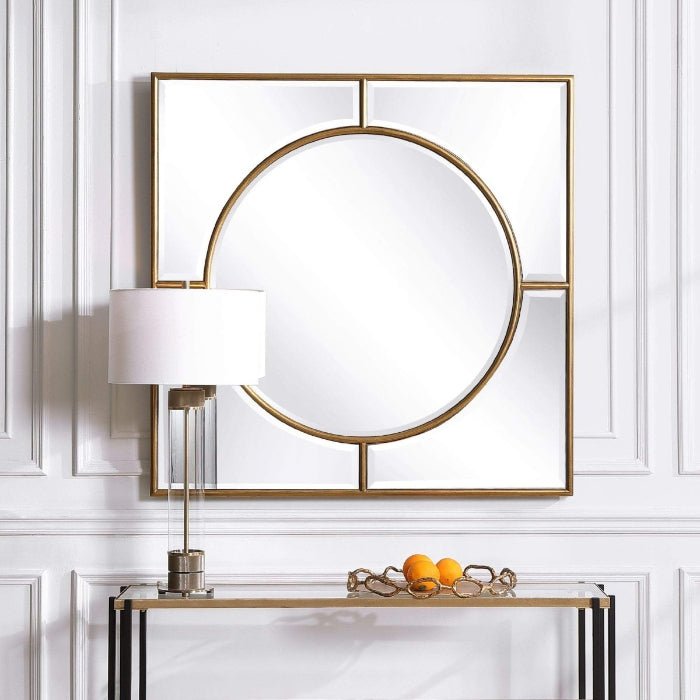
Square wall mirrors are one of the easiest ways to make a space feel more intentional. They add structure, clean lines, and symmetry—without looking “too designed.” The key is choosing a size that fits the wall and hanging it at a height that feels natural (not floating, not too low, and not competing with your lighting).
Why square mirrors work so well
In design, squares read as stable. They’re great when you want a room to feel grounded and polished—especially in spaces that already have a lot of curves (arched doorways, rounded furniture, soft textiles) or lots of visual movement (gallery walls, patterned rugs, busy countertops).
A square mirror also gives you a built-in “frame” for styling. It creates a clear edge that helps you align lamps, art, and decor—so the whole vignette looks calmer, even if the pieces are eclectic.
How to choose the right size
The fastest way to get the scale right is to think in percentages instead of inches. Aim for the mirror to be wide enough to relate to what’s under it (console, vanity, dresser) but not so wide that it overwhelms the furniture.
| Where it goes | Best width guideline | Spacing to leave |
|---|---|---|
| Over a console table | Mirror width ≈ 60–80% of console width | Bottom edge about 6–10 in above the tabletop |
| Over a bathroom vanity | Mirror width ≈ 70–90% of vanity width (single sink) | Bottom edge about 4–8 in above the faucet/backsplash |
| Over a dresser | Mirror width ≈ 60–80% of dressers width | Leave 6–10 in between the dresser top and mirror. |
| On an empty wall | Choose a size that “talks to” nearby furniture—use a larger mirror if the wall feels bare | Keep at least 6–12 in from the door trim and adjacent art |
The best hanging height (simple rules)
Most mirrors look “off” for one of two reasons: they’re hung too high, or they’re centered relative to the wall but not relative to the person using the space.
Rule 1: Aim for eye-level centering
A reliable starting point is to hang the mirror so the center sits around 60–64 inches from the floor (depending on your household height). This is especially helpful for standalone mirrors on open walls.
Rule 2: Over furniture, relate to the vignette—not the ceiling
When a mirror is above a console, dresser, or vanity, what matters is the relationship between the mirror and the furniture. Don’t push the mirror up to “fill the wall.” Keep the gap consistent (usually 6–10 inches) so the whole arrangement reads as one intentional composition.
Rule 3: Light fixtures should frame the mirror, not fight it
If you have sconces, let them sit just outside the mirror’s edges or slightly above the top corners. For bathrooms, avoid hanging a mirror so high that the sconces feel low and awkward. If you’re using a picture light, keep it proportionate and centered—squares look best with symmetry.
Room-by-room placement tips
Entryway
A square mirror in an entryway is all about function (quick check before you leave) and balance (it anchors the console vignette). Pair a square mirror with a long, low console to create a modern silhouette—then soften the look with a textured runner, a ceramic bowl, or a small stack of books.
If your entry is narrow, keep the frame slimmer and the mirror a bit larger. A thin frame reads lighter visually and helps the space feel more open.
Bathroom
For single-sink vanities, a square mirror feels crisp and modern. Choose a width that aligns with the vanity (or is slightly narrower) so it doesn’t feel like it’s “spilling” beyond the cabinetry. If you have a wide vanity, consider two square mirrors—one per sink—for a clean, hotel-like look.
Bedroom
Over a dresser, a square mirror brings order—especially if your bedding is soft and layered. If your bedroom already has a lot of straight lines (platform bed, boxy nightstands), add warmth with wood tones, brass accents, or a linen-shade lamp near the mirror vignette.
Living room
In a living room, square mirrors are great for creating a “moment” on a wall that might otherwise feel empty. Hang one above a bar cabinet, a small console, or a low credenza. If you have a fireplace, a square mirror can look especially modern when the frame is thin and the surrounding styling is restrained.
Styling: what to reflect + what to avoid
Mirrors don’t just add light—they double whatever they face. Before you hang a mirror, stand where it will be placed and look at what it reflects. The goal is to reflect something you’re happy to “feature” twice.
Great things to reflect
- Windows: makes a room feel brighter and bigger
- Artwork: especially bold pieces—mirrors can echo color nicely
- Greenery: adds life without taking up floor space
- Lighting: warm lamps + sconces can create a glow that feels expensive
Things to avoid reflections
- Cluttered countertops or messy “drop zones”.
- Harsh overhead fixtures or exposed bulbs (unless that’s your aesthetic)
- Busy TV walls—mirrors can add extra distraction
For square mirrors, try styling with symmetry first (two lamps, two sconces, or a centered vase). Once the layout feels calm, you can add a more organic element like branches, textured ceramics, or a small sculptural object.
Square mirror picks from Modest Hut
If you’re ready to shop, start with our Square Mirrors collection. Below are a few favorites that work in a wide range of spaces.
Tip: The images below use the second product gallery photo (so you can see styling/angle options beyond the hero shot).


FAQ
What size square mirror should I put over a console table?
A great rule of thumb is to choose a mirror that’s about 60–80% of your console’s width. Keep the bottom edge roughly 6–10 inches above the tabletop so the arrangement reads as one cohesive vignette.
How high should I hang a square mirror?
If it’s on an open wall, start by placing the center of the mirror around 60–64 inches from the floor (then adjust for your household). If it’s over furniture, focus on a consistent gap—typically 6–10 inches above the surface.
Can a square mirror work in a small entryway?
Yes—square mirrors are especially good in small entryways because their clean geometry keeps the space from feeling busy. A slimmer frame and a slightly larger mirror can help the area feel brighter and more open.
Are square mirrors better than round mirrors?
Neither is “better,” but they feel different. Squares look structured and modern; rounds feel softer and more organic. If your space already has many curves, a square mirror can add balance—if your space feels too sharp, a round mirror can soften it.
What should a mirror reflect for the best look?
Try to reflect something you’d be happy to feature twice—like a window, artwork, greenery, or a warm lamp. Avoid reflecting clutter or harsh overhead lighting whenever possible.




Leave a comment
This site is protected by hCaptcha and the hCaptcha Privacy Policy and Terms of Service apply.