

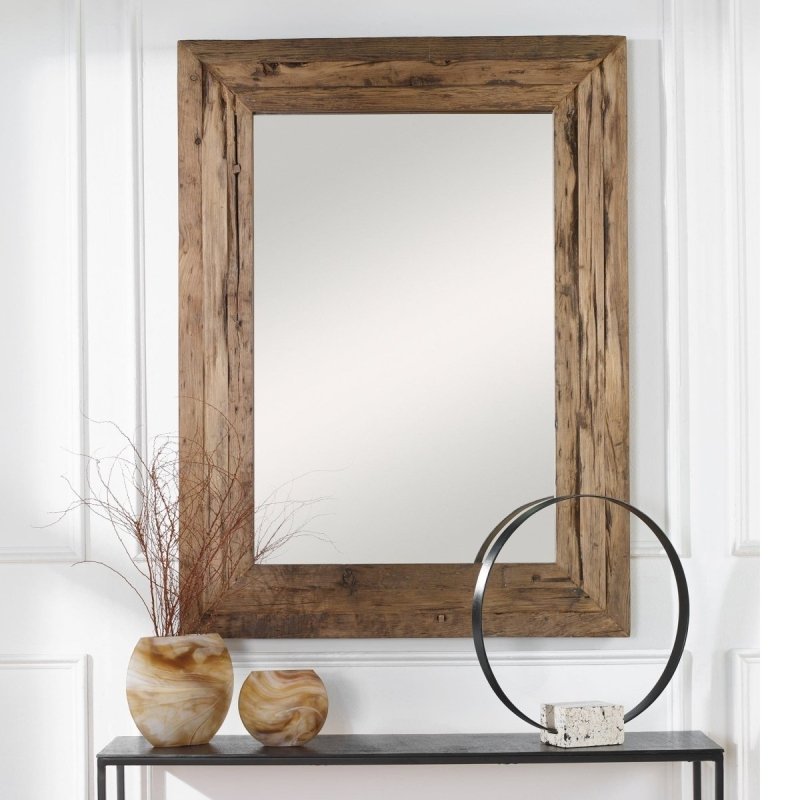
Wood framed mirrors are one of the fastest ways to make a room feel warmer and more “designed.” The catch: wood has an undertone (golden, red, gray, or neutral) and if it fights your floors or furniture, the mirror can look accidental. This guide is a practical way to pick the right finish, size it correctly, and style it so it feels intentional—without trying to match every wood surface.
Pick the right wood finish (undertones matter more than “light vs dark”)
When people say a mirror “doesn’t work,” it’s usually not the shape—it’s the undertone. A warm honey oak and a cool gray-washed wood can both be “light,” but they read completely different in a room. Use this simple sorting method:
Warm undertones
Look for woods that read golden, amber, caramel, or slightly reddish. These play nicely with warm whites, beige, brass, and warm wood floors.
- Best with: brass, aged bronze, creamy white paint, warm oak/walnut furniture
- Feels: cozy, traditional-to-modern organic
- Watch for: mixing with very cool grays (can look yellowed)
Cool / neutral undertones
Look for woods that read natural (neutral) or slightly gray-washed. These are easiest in crisp-white, black-metal, and cooler gray interiors.
- Best with: matte black, brushed nickel, bright white trim, cooler floors
- Feels: modern, clean, lightly rustic
- Watch for: pairing with very orange/amber floors (can look mismatched)
If you’re starting from scratch, browse our Wood Mirrors collection first, then cross-check against your floor or your largest wood furniture piece. If you want a cleaner, more minimal look, you can also compare against Modern Mirrors.
Frame profile + visual weight (why thin frames feel bigger)
The frame isn’t just decoration—it changes how large the mirror feels on the wall. A thin frame makes the reflective surface feel larger; a thick frame reads more like furniture.
| Frame style | Best for | Design note |
|---|---|---|
| Thin / clean frame | Small rooms, hallways, minimal spaces | Makes the mirror feel lighter; easiest to mix with other finishes. |
| Medium frame | Most living rooms + bedrooms | The safest choice when you want warmth without the mirror feeling heavy. |
| Thick / rustic frame | Spaces that need grounding | Reads like a statement piece—leave more negative space around it. |
Sizing rules (the ones designers actually use)
A wood-framed mirror looks best when it relates to the furniture under it. Use these sizing rules as a starting point, then adjust for your ceiling height and wall space.
| Where the mirror goes | Width guideline | Height guideline |
|---|---|---|
| Above a console / entry table | ~2/3 to 3/4 the console width | Tall enough to reflect light, but leave breathing room above. |
| Above a dresser | ~2/3 the dresser width | Pick height based on what you want reflected (face vs full upper body). |
| Over a fireplace mantel | Usually narrower than the mantel | Keep the top from touching the ceiling line; avoid a “stacked” look. |
| Leaning floor mirror | Wide enough to feel stable | Best when taller than the person who uses it most often. |
Placement + hanging height (so it reflects what you want)
The most useful “rule” is a sightline rule: hang the mirror so it reflects the part of the room you want more of—light, space, or a focal point. Use these starting points:
- Center height: aim for ~57–60 inches from the floor to the mirror’s center (adjust for your household).
- Above furniture: leave ~6–10 inches between the top of the furniture and the bottom of the mirror.
- Entryways: place so you can do a quick check without seeing mostly ceiling.
If you’re deciding between shapes, this comparison can help: Arched vs. Rectangular Mirrors: Which Style Works Best?. For more options, browse Rectangular Mirrors or Arched Mirrors.
How to mix wood tones (without clashing)
Matching every wood surface can make a room feel flat. Instead, aim for two to three wood tones that share an undertone. Wood framed mirrors are great for bridging those tones because they sit at eye level.
- Repeat, don’t match: echo the mirror’s undertone elsewhere (a shelf, a bowl, a frame).
- Use contrast intentionally: a darker wood mirror can anchor a light room; a light wood mirror can brighten a dark wall.
- Keep one “hero” wood: floors or the largest piece should lead; the mirror supports.
- Add texture: woven baskets, linen, or stone make mixed woods feel curated, not chaotic.
If you’re building a warm, organic wall, pairing a wood-framed mirror with carved pieces is an easy win: Wood Wall Decor complements wood mirrors without looking “matchy.”
Care + cleaning basics
Clean the glass separately and keep sprays away from the frame when possible—excess moisture is the biggest enemy of wood finishes.
- Dust the frame with a dry microfiber cloth.
- Spray glass cleaner onto the cloth (not the mirror) and wipe the glass.
- For bathrooms, ensure good ventilation and avoid placing wood mirrors where they get direct steam daily.
FAQ
Should a wood framed mirror match my floors?
It doesn’t have to match exactly. The safest approach is matching the undertone (warm vs cool) and letting the shade vary. That variation is what makes a room look layered and intentional.
How high should I hang a mirror above a console table?
Start with about 6–10 inches between the console top and the bottom of the mirror, then adjust so the mirror reflects what you want (not mostly ceiling). If you prefer a universal reference point, aim for the mirror’s center around 57–60 inches from the floor.
Can I use a wood framed mirror in a bathroom?
Yes, as long as the finish is sealed and your bathroom has good ventilation. Avoid placing it where it gets direct steam every day, and wipe condensation promptly if it occurs.
What shape is easiest to style with wood frames?
Rectangles are the easiest because they align with most furniture lines. Round wood mirrors feel softer and work beautifully in bedrooms, bathrooms, and smaller entryways where you want the space to feel less angular.
How do I mix wood mirrors with metal finishes?
Choose one dominant metal (brass, black, or nickel), then treat the wood frame as the “warmth layer.” Repeat the metal finish at least twice (hardware + lamp, for example) so the mix feels intentional.
Shop wood framed mirrors
Start with our Wood Mirrors collection, then use the finish + sizing rules above to narrow quickly. If you want to compare across styles, browse Modern Mirrors as well.



%20and%20if%20it%20fights%20your%20floors%20or%20fu...)
Leave a comment
This site is protected by hCaptcha and the hCaptcha Privacy Policy and Terms of Service apply.